
Geodesic dome vs cabin: which costs less to build?
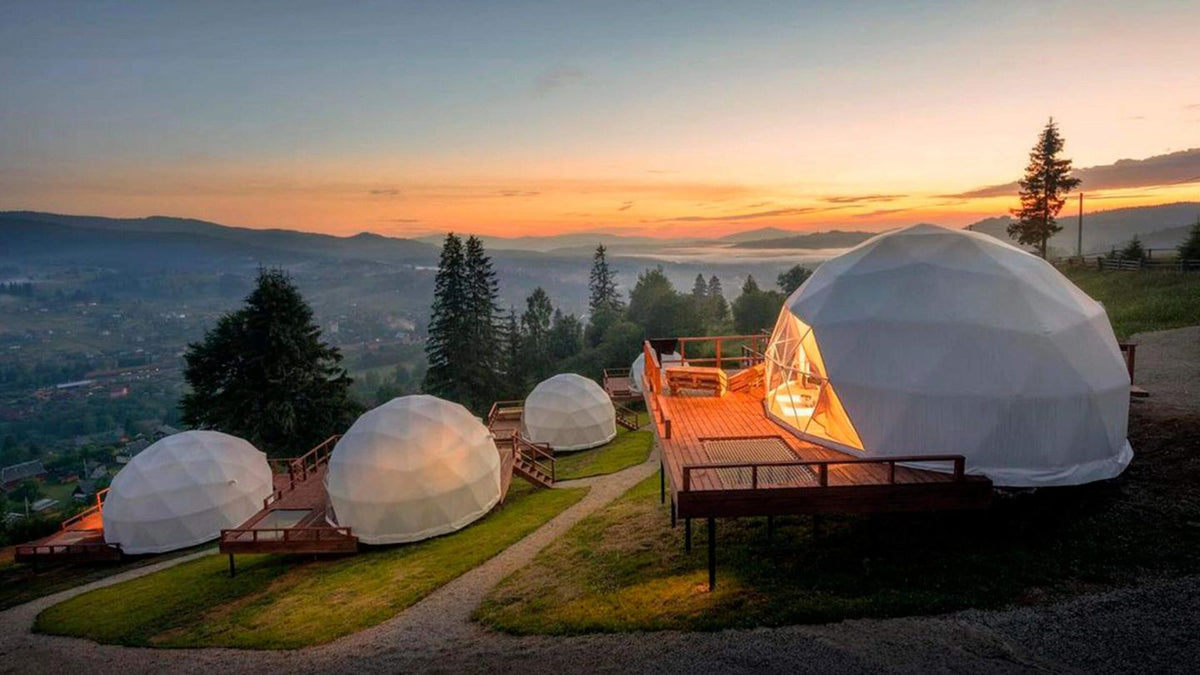
A geodesic dome usually costs less to build than a cabin of the same size, and most of the saving shows up in the shell. Harmony's 7m dome covers 415 square feet and starts at $10,125 for the kit, which lands at roughly $24 per square foot for a weather-tight structure, while a comparable cabin shell generally starts around $50 per square foot once framing, sheathing, roofing, and siding are done.
The sticker price is the easy half of the answer. The useful half is knowing which line items move, because that is where your budget is really decided.
Geodesic dome vs cabin cost, side by side
Here is the same 415 square foot footprint, priced two ways. The dome figures are Harmony's published kit prices. The cabin figures are market ballparks, since they swing with your contractor and your region.
| Line item | Geodesic dome (415 sq ft) | Small cabin (415 sq ft) |
|---|---|---|
| Weather-tight shell | $10,125 to $12,100, depending on framing tier | $20,000 to $40,000 |
| Shell cost per square foot | about $24 to $29 | about $50 to $100 |
| Time to a closed shell | 2 to 5 days with a crew of 4 to 6 | 3 to 8 weeks |
| Finished and lived in | $150 to $250 per sq ft | $150 to $300 per sq ft |
Scale tilts the comparison further. Our largest dome covers 804 square feet and starts at $15,925, which is closer to $20 per square foot of shell. A cabin generally holds its per-foot cost as it grows, since every extra foot needs more framing, more roof, and more siding.
Why a dome costs less to put up
Three things do the work. The shape encloses the most space for the least surface, so there is simply less material wrapping the same floor area. The frame carries the load as one connected structure, which replaces the walls, rafters, and trusses a cabin needs to do the same job separately. And assembly runs in days rather than weeks, which matters because labor is the fastest-moving line in any build.
Running costs follow the same logic. A round envelope has less exposed surface to lose heat through, and one 24,000 BTU unit typically handles heating and cooling for a dome that a cabin of the same size would ask more of. How to think about it: the geometry keeps paying you back every month, long after the build is done.
Where a cabin earns its price
A cabin is worth its cost when the building needs to read as a conventional house. Square walls take standard furniture and standard cabinetry without a second thought, any local contractor can price the work from memory, and appraisers, lenders, and future buyers already have a mental slot for it.
A dome earns its price on a different axis. It draws bookings, photographs beautifully, and puts up a certified four-season structure for less. How to think about it: choose the cabin when the building has to blend into a conventional neighborhood, and choose the dome when the building has to feel like somewhere worth staying, or when you want more square footage for the same money.
How to compare the two fairly
Shell price alone will mislead you in both directions. Put the same seven lines next to each other: shell, foundation, freight, utility hookups, interior fit-out, permitting, and the weeks of labor each one takes. A dome tends to win clearly on shell and labor, sit roughly even on foundation and utilities, and finish ahead overall on most projects we see.
If you want the full picture on the dome side of that spreadsheet, our complete guide to what a geodesic dome costs itemizes a real guest-ready build from kit to permit. And because every size and framing tier has a published price, you can put a firm dome number beside your contractor's cabin estimate before you commit to either.
Is a geodesic dome cheaper than a cabin?
Usually yes, especially on the shell. A 415 square foot Harmony dome kit starts at $10,125, roughly $24 per square foot, where a cabin shell of the same footprint commonly starts near $50 per square foot. Finished out as living space, both land in a similar $150 to $250 per square foot band, so the dome's advantage comes mostly from the structure and the days of labor it saves.
Does a dome cost less to heat than a cabin?
Generally it does. The round shape has less exposed surface per square foot of floor, so it holds temperature well, and a single 24,000 BTU unit usually covers heating and cooling. Insulation choice sets the rest: a foil liner suits mild climates and seasonal use, while multi-layer insulation or spray foam carries a dome comfortably through hard winters.
Does a dome hold up as well as a cabin?
Yes, and often better in weather. The frame is powder-coated steel engineered for a 20-plus year structure, the cover is Belgian architectural PVC at 650 g/sqm, and the setup can be built to stand wind up to 250 mph depending on the framing you choose, certified by a structural study. Frame and cover carry a 5 year warranty, with windows and defects covered 14 months.
Ready to put a number on it?
Build and price your dome